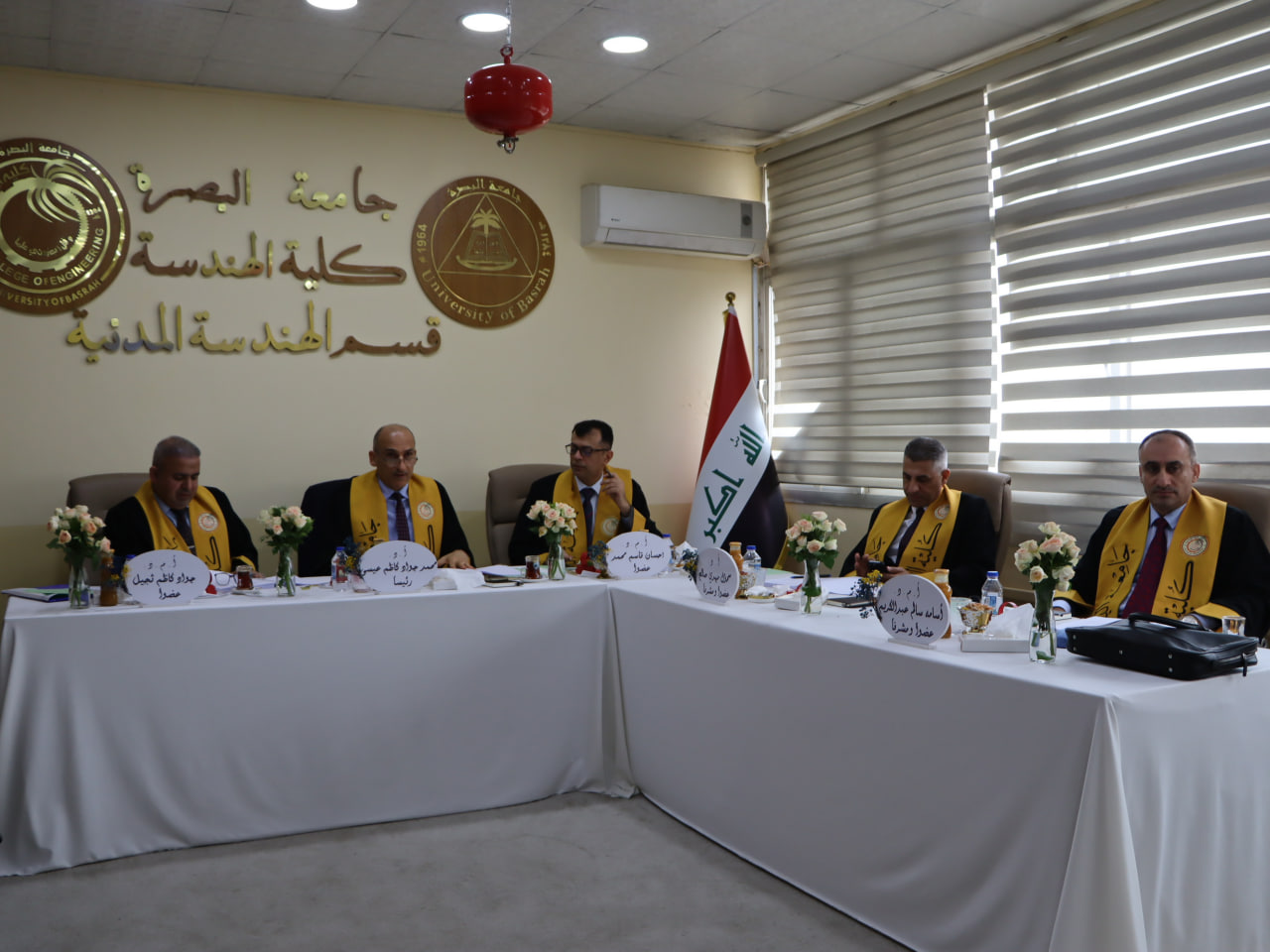
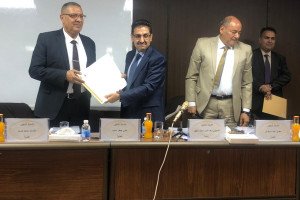
The Master's thesis of researcher Marwa Fadhil Hamed, supervised by Professor Dr. Samouel Mahdi Saleh and Assistant Professor Dr. Osama Salem Abdul Karim, was discussed at the College of Engineering, University of Basra, Department of Civil Engineering. The thesis, titled Numerical Analysis of Geogrid-Encased Stone Columns for Improving Basrah Soft Soil includes...
Soft cohesive deposits are widespread in the Basrah region, southern Iraq, due to low undrained shear strength, high compressibility, and lack of natural lateral support, thereby causing poor bearing capacity and high settlements. The use of ‘Geogrid-Encased Stone Columns’ GESCs, compared to ‘Ordinary Stone Columns’ OSCs, provides additional confinement benefits, resulting in effective prevention of bulging. A three-dimensional finite-element analysis using PLAXIS 3D version 2024 software has been conducted to analyze the bearing capacity of a floating OSC and GESC. For the granular column material, the Mohr–Coulomb model was employed, and for the clay, the Hardening Soil model. Model reliability was confirmed through comparison with two well-documented field cases.
The research examined three soft clay sites in Basrah (Al-Sarrajy, Bab Al-Zubair, and Al-Fao) to evaluate the influence of column length, diameter, encasement length, and encasement stiffness on the bearing capacity. The results showed that the relative benefit of encasement is strongly governed by the native soil strength, encasement delivered larger percentage gains in Al-Sarrajy site (Su≈25 kPa) and Bab Al-Zubair site (Su≈18.9 kPa) than in Al-Fao site, where the unimproved soil (Su≈34.5–42.5 kPa) was already relatively stronger. The ideal practical encasement length was found to be approximately two-thirds of the column length, with minor additional benefit beyond this limit. The additional diameter has contributed more than the additional length, except for a moderate L/D ratio, while geogrids with a minimum axial stiffness (EA) of 120 kN/m have consistent performance.
In summary, it has been confirmed that a balanced approach is necessary in the design, as GESC can provide a beneficial improvement in soft Basrah clay. However, their efficiency becomes a function of the native undrained strength and geometry of the column, as well as the stiffness of the encasement. In addition, in clay of moderate strength, floating GESCs can approach the settlement performance of driven piles, thereby suggesting GESCs as a viable, cost-effective option in moderate loads where bored piles are not economically feasible.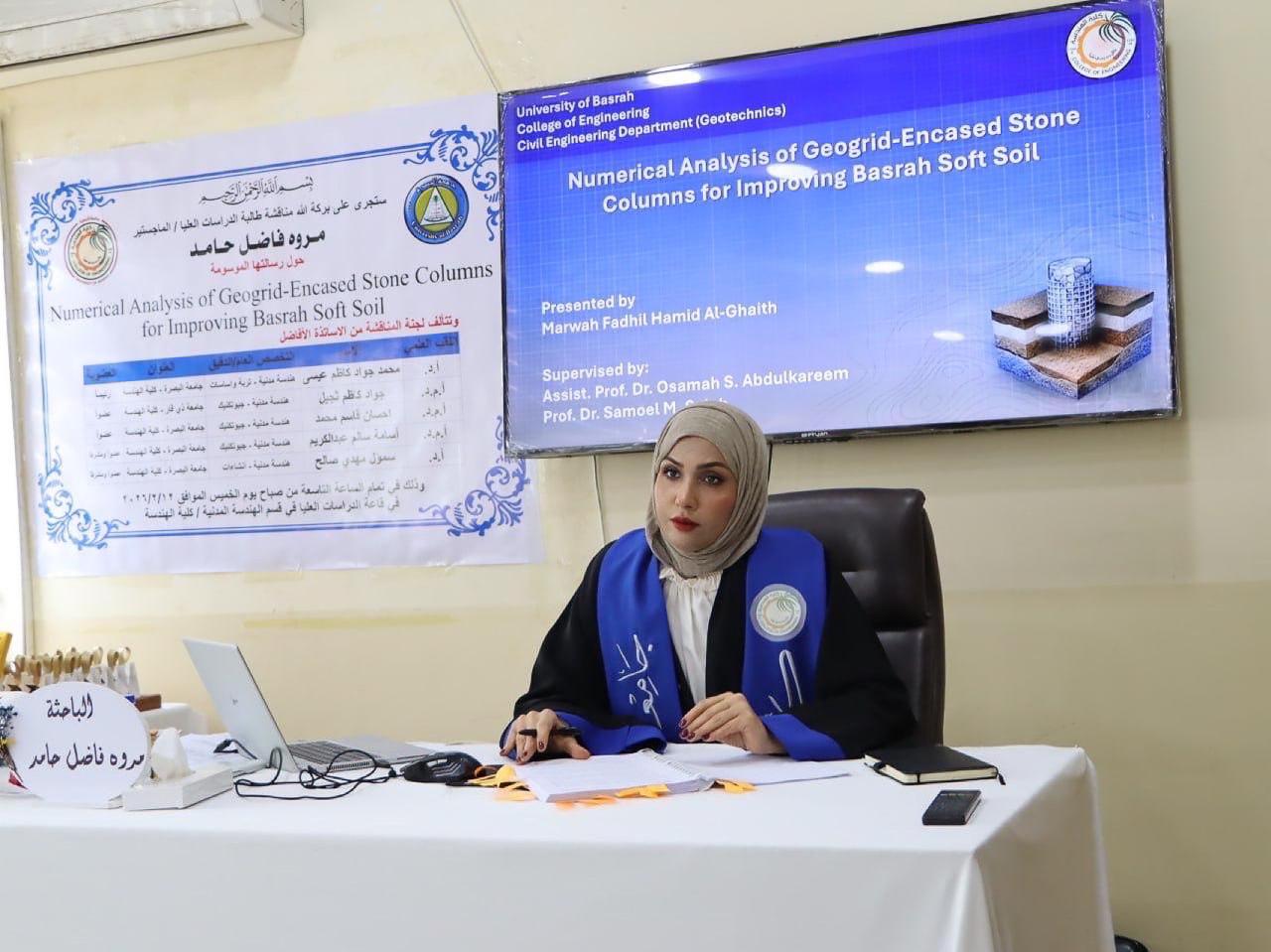
Important News
viewed most