
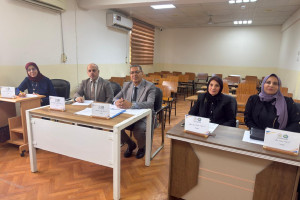
The Master's thesis of researcher Salah Adnan Salim was discussed at the College of Engineering, University of Basra, Department of Civil Engineering, under the supervision of Professor Dr. Haider Saad Yassin and Assistant Professor Dr. Ahed Zuhair Hammoudi. The thesis was titled Evaluation of Cone Penetration Test Uses in Basrah Soil. The Cone Penetration Test (CPT) is one of the most extensively applied in-situ
techniques for assessing soil behavior, particularly in soft, layered, and
heterogeneous sedimentary environments. Although numerous (CPT)-based
empirical correlations have been proposed globally, the majority were developed
under geological and climatic conditions that differ substantially from those found
in Basrah Governorate, southern Iraq. Such differences highlight the need for
locally calibrated correlations to enhance the accuracy and reliability of
geotechnical evaluations in the region.
This study focuses on developing site-specific (CPT) correlations for estimating
the undrained shear strength (su) of soft to medium-stiff clayey and silty soils in
Basrah. A comprehensive database of more than (150 CPT) soundings obtained
from Shuaiba, Umm Qasr, and Majnoon sites was compiled and analyzed. The
(CPT) measurements were supported by high-quality field vane shear and
laboratory tests, including unconfined compression (UCS) and unconsolidated
undrained (UU) triaxial tests, ensuring a reliable comparison between in-situ and
laboratory-derived strength parameters.
To establish robust empirical relationships, both linear and multiple linear
regression analyses were conducted to examine the influence of cone tip resistance
(qc) and sleeve friction (fs) on undrained shear strength. A suite of statistical
assessments including normality testing, Pearson correlation, and analysis of
variance (ANOVA) was performed to evaluate the significance, consistency, and
reliability of the developed models.
I
The analysis demonstrates that cone tip resistance (qc) is the dominant predictor of
undrained shear strength (su), whereas the inclusion of sleeve friction (fs) does not
lead to notable improvements in model performance. The developed regression
models yielded strong coefficients of determination (R²) values of (0.812, 0.759,
and 0.733) for Shuaiba, Umm Qasr, and Majnoon, respectively, confirming the
consistency of (su-qc) correlations across all study sites. Furthermore, the
calculated cone factors (Nk) show a clear decreasing trend with increasing soil
stiffness, with values of (19.3–20.3) for soft soils, (10.5–15.7) for medium-stiff
soils, and (7.1–9.4) for stiff soils. Overall, the study provides reliable, site-specific
(CPT) correlations tailored to Basrah’s soil conditions and offers an improved
framework for predicting undrained shear strength in regional geotechnical design and analysis..jpg)
Important News
viewed most