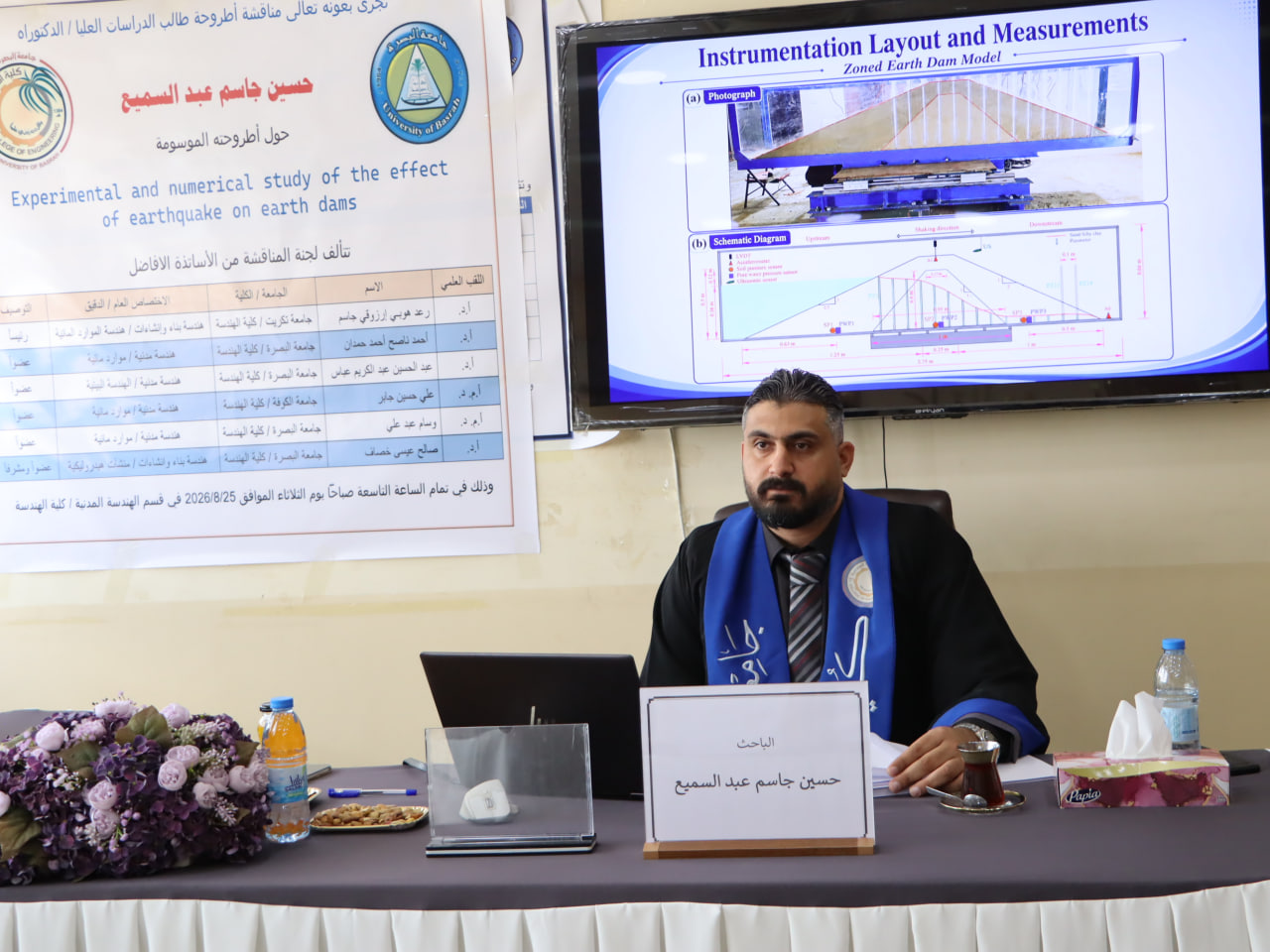
The PhD dissertation of researcher Hussein Jassim Abdul-Sami was discussed at the College of Engineering, University of Basra, Department of Civil Engineering, under the supervision of Professor Dr. Saleh Issa Khassaf, entitled: Experimental and Numerical Study of the Effect of Earthquake on Earth Dams
Earth dams are strategic hydraulic structures for water storage and water security. Their failure may release large volumes of water and cause severe downstream losses. This concern is particularly relevant to Iraq, where dams represent essential infrastructure for water resources management, while recorded seismic activity in several dam regions, seepage conditions, and the use of different local soils require continued evaluation of dam safety.
The present study aimed to evaluate the hydraulic and seismic response of homogeneous and zoned earth dam models constructed from different soil materials, with and without a horizontal downstream filter. It also aimed to identify the most critical zoned configuration and examine the effectiveness of improving its vulnerable shell material. Physical shaking-table tests were combined with numerical analyses to evaluate the measured response and estimate the safety factor of the upstream and downstream slopes.
The experimental program was conducted using a transparent-sided flume mounted on a single-degree-of-freedom horizontal shaking table. Seventeen earth dam configurations were divided into three main groups. The first group comprised six homogeneous models constructed from silty clay, sand, and a sand–gravel mixture referred to as subbase, with each material tested with and without a horizontal downstream filter. The second group comprised nine zoned models, including three shell–core configurations without a filter, three corresponding configurations with a horizontal filter, and three models with gravel shells. The third group comprised two improved-shell models in which the sand shell of the critical Sand–Silty clay configuration was treated with either 0.5% polypropylene fibers or 3% ordinary Portland cement. The untreated Sand–Silty clay model, which was included in the zoned group, was used as the reference case for assessing the improvement.
All models were prepared with the same general geometry, reservoir level, and testing sequence. A steady-state seepage condition was established before dynamic loading. The models were then subjected to the El Centro earthquake record scaled to peak ground acceleration levels of 0.1g, 0.2g, 0.3g, 0.4g, and 0.5g. The assessment included seepage discharge, phreatic-line position, crest acceleration, PGA amplification, spectral response, relative crest displacement, permanent crest settlement, pore-water pressure, effective stress, slope stability, crack width, and visible damage.
The homogeneous earth dam models' resultsdemonstrated a clear influence of soil type and horizontal filtering. The subbase models showed the most stable response, especially with the presence of the horizontal filter, which provided the best overall behavior within the homogeneous group. The unfiltered silty clay model represented the most critical homogeneous case and was the most susceptible to pore-water pressure buildup, effective-stress reduction, deformation, cracking, and slope instability. At 0.5 g, its downstream factor of safety decreased to approximately 1.1, while the maximum crest crack width reached about 21 mm. Although thepresence of the horizontal filter increased the collected seepage discharge, it lowered the phreatic line near the downstream side, which led to reduced downstream saturation and increase effective-stress and thus improved stability responses.
The tested zoned earth dam models in the second group showed clear differences in seismic response depending on shell-core material type and downstream drainage condition. The finer configurations developed higher pore-water pressure, lower effective stress, larger deformation, a highercrest amplification factor, and more visible damage, whereas the gravel shell models gave the most stable overall response. The horizontal filter had little influence at the upstream side, but it became more effective at the center and had significant influence at the downstream side, where it improved stability by reducing pore water pressure and maintaining higher effective stress. Overall, the Sand-Silty clay modelswere the most critical case, and the subbase configurations showed intermediate behavior, while the gravel-shell configurations showed the best seismic performance and the highest overall stability.
The third group examined the improvement of the Sand-Silty clay zoned dam model, which was the most critical case in the previous groups, by modifying only the sand shell while fixing the silty clay core and model geometry. The results showed Improvement of the sand shell modified the hydraulic and seismic behavior. The total discharge remained controlled mainly by the low-permeability core, with only small differences among the three models. Fiber reinforcement increased the discharge by approximately 2.23% and lowered the downstream seepage line, whereas cement treatment reduced the discharge by approximately 10.41% but produced a higher downstream wetting. Under seismic loading, both treatments reduced deformation and damage. At 0.5 g, permanent crest settlement decreased from about 26 mm in the untreated model to approximately 18 mm in the fiber-reinforced model and 5 mm in the cement-treated model. The maximum crack width was limited to about 15 mm with polypropylene fibers and about 5 mm with cement treatment. Cement treatment also maintained the highest effective stress and factor of safety, while fiber reinforcement produced an intermediate improvement.
Overall, the study demonstrated that the earthquake response of earth dams is strongly governed by material type, shell–core composition, drainage condition, and the location and type of soil improvement. Horizontal filtering primarily improved the downstream hydraulic and stability conditions, gravel shells provided the most stable zoned response, and cement treatment was the most effective method for improving the critical sand shell..jpg)
Important News



viewed most