The Master's thesis of researcher Huda Ali Hassan was discussed at the College of Engineering, University of Basra, Department of Computer Engineering, entitled Development of a Granular Jamming Soft Robot for Human Backbone Support
In a society that is experiencing an increase in the prevalence of injuries, various diseases, and aging, it is crucial and imperative to innovate in the field of humanitarian assistance. Soft robots have been implemented in numerous industrial and medicinal applications due to their superiority over rigid robots, particularly in the context of human-machine interaction. This research involves the construction and design of a flexible upper body robot, specifically for the back, designed to support and rehabilitate the spine. This robot utilizes flexible Pneumatic Muscle Actuators (PMAs). A pneumatic muscle capable of contraction is constructed and designed. This muscle is tested to determine its behaviour under varying pressures, and its strength and load-bearing capacity are assessed. It achieved maximum contraction by amount 24 cm at a pressure of 500 kPa and generated a force of 333 N at the same pressure. A mathematical model (Sigmoidal model) is developed to description the hysteresis characteristics of pneumatic muscles,high modelling accuracy is achieved with correlation coefficient = 0.996 for both increasing and decreasing pressure and a low error of MSE = 0.15776, and the results demonstrated the model's accuracy in describing the nonlinear hysteresis behavior of the muscle .After constructing the robot and integrating the muscles into its exoskeleton, the robot is activated to perform back rehabilitation exercises and a Sliding Mode Control (SMC) system is selected to manage the robot's movements to meet the therapeutic needs. The robot's ability to move smoothly and comfortably is its most important feature and it consists of three pneumatic muscles and robot weighs 880 g. Furthermore, another robot, based on a granular jamming system, is designedand demonstrated its ability to provide back support by adjusting its rigidity according to conditions, from a flexible to a rigid state as needed. A test is conducted to measure it stiffness, achieved a stiffness increase from 1.88 N/rad to 1691.84 N/rad as pressure rose to 400 kPa, and the experiment showed that increasing pressure significantly increases rigidity. The robot weighs 1Kg.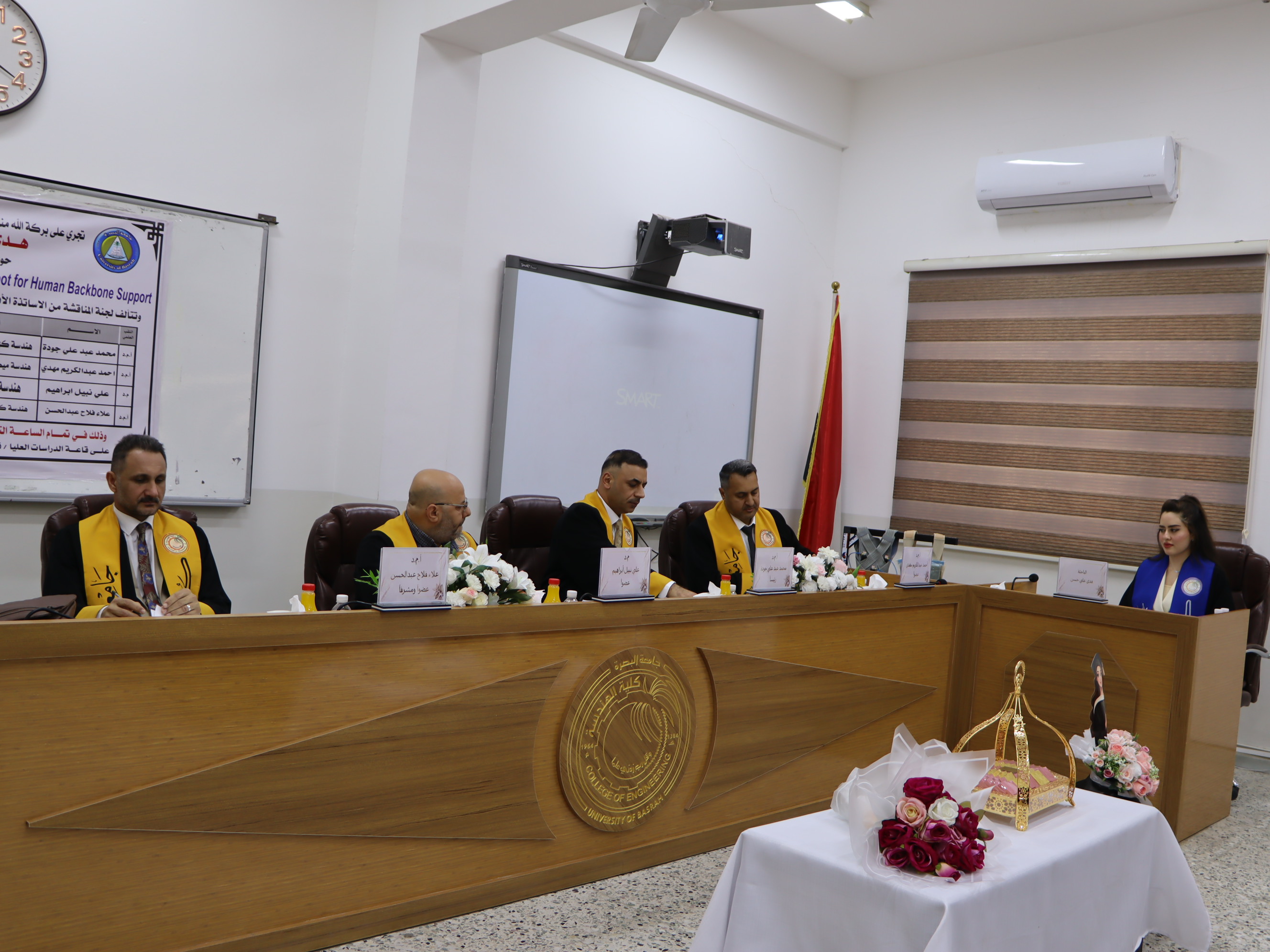
Important News


viewed most