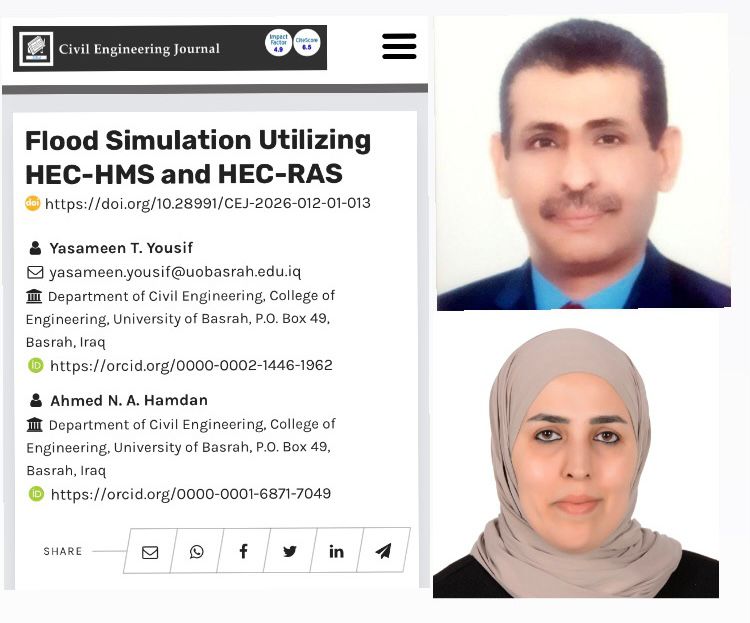
Professors from the Civil Engineering Department, Dr. Ahmed Naseh Ahmed Hamdan and Lecturer Yasmin Tahseen Yousef, co-authored a research paper titled "Flood Simulation Utilizing HEC-HMS and HEC-RAS"
published in the Civil Engineering Journal, published by the Salehan Institute of Higher Education. This peer-reviewed journal is indexed in Scopus and ranks in the first quartile (Q1) of international scientific journals, with a CiteScore of 6.5 and an IF of 4.9. The study concluded that heavy rainfall leading to surface runoff in floodplain areas poses risks to the populations of these areas and surrounding regions. Therefore, flood simulation is essential for accurately assessing risks and developing effective water use strategies. In this research, hydraulic and hydrological models, supported by Geographic Information Systems (GIS), were used to simulate the mechanisms of rainwater runoff in the governorate of Wasit, central Iraq. A 30-meter digital elevation model (DEM) was provided by the United States Geological Survey (USGS), geospatially processed, and imported into the Hydrological Modeling System (HEC-HMS) at the Hydrological Engineering Center. Surface runoff within the study area was estimated using the SCS-CN methodology. To determine curve values (CN), several datasets were collected, including those related to land use, land cover (LULC), and soil types. The HEC-HMS was supplied with CN values extracted from the geographic information systems, ranging from 73.95 to 97.61. During the November 2015 rainfall event, the Hydrological Engineering Center's River Analysis System (HEC-RAS) was used to simulate flooding using the surface runoff data generated by the HEC-HMS. Inundation maps were produced using the RAS-Mapper software within the HEC-RAS system, illustrating the depth, velocity, and extent of the flood in the study area. The flood model was calibrated by comparing simulation results with satellite imagery from November 14, 2015. Using the Flood Sensitivity Index (CSI), hydrological factors Ia, Muskingum K, and X, as well as the percentage of impermeable surfaces, were adjusted through sensitivity analysis to achieve the highest possible convergence between the model and the satellite imagery. The results were a Flood Sensitivity Index of 88.56%, Hydrological Conformity (HR) of 96.31%, and FAR of 8.33%. The parameters were validated, and the results were compared with satellite imagery from April 3, 2019. The high level of conformity allowed for the adoption of the final flood map. This study highlights the importance of measuring surface runoff for efficient water resource management and flood risk reduction. The model can be used in the future to predict rainfall-induced floods, enabling proactive measures and solutions to mitigate their impact on the local population or to utilize this water volume during dry seasons.
The full research paper can be read here. Click on the link below:
https://www.civilejournal.org/index.php/cej/article/view/6356
Important News


viewed most