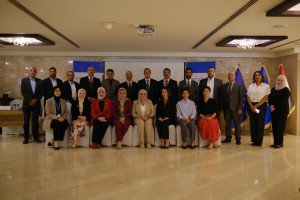
The Master's thesis of researcher Jinan Ali Abdul Karim was discussed at the College of Engineering, University of Basra, Department of Civil Engineering, under the supervision of Professor Dr. Ammar Salman Dawood and Assistant Professor Dr. Ihsan Qasim Mohammed. The thesis, titled " Application of Artificial Intelligence For Predicting Field Soil Density includes...
In geotechnical engineering, soil compaction is very important in determining the degree of soil dry density because it enhances engineering soil properties and stability and durability of all construction projects. To assess the effectiveness of compaction activities, it is important to measure the degree of density and there are a number of ways of doing so in the field. Various methods can be used to measure this parameter and each has its merits and demerits. The selected approach tends to rely on project requirements, the materials involved, as well as the accuracy of the necessary measurements. Algorithms of artificial intelligence can learn the complicated associations between field density and soil parameters and could possibly defeat the difficulties of conventional methods. The possibility to handle big data and take into consideration nonlinear correlations makes AI an especially appealing option.
Because of the scarcity of studies on the application of AI methods to determine the soil density, The study employs an ensemble decision tree method, support vector machine (SVM), artificial neural network (ANN), and multiple regression analysis (MLR) techniques to predict the soil density in the Basra-Faw Road project. Eighty-six soil samples were collected and the relevant experiments carried out in the laboratory as well as in the field. The tests were used to measure the particle size distribution (gravel, sand, fine content), and Atterberg limits (plasticity, liquid limit). The three AI models were selected to estimate the soil density factor by using the soil parameters (gravel, sand, fine content, plasticity and liquid limit) as the input in the models.
This study was aimed at determining the accuracy of prediction through the correlation coefficient and the RMSE (Root Mean Square Error). Compared to it, the findings of the present research revealed the better functionality of the artificial neural network model in terms of predicting precision with a 0.98786 R-squared value.
Important News


viewed most