Assistant Professor Dr. Osama Salem Abdul Karim and Assistant Professor Dr. Ihsan Qasim Mohammed, faculty members in the Department of Civil Engineering at the College of Engineering, University of Basrah, published their research paper in the Journal of King Saud University - Engineering Sciences, published by the international publishing house Springer Nature. The journal is indexed in Scopus (Q1) with a Citescore of 12.1. The research paper is titled: Assessment of a new pluviation system designed to prepare uniform samples of sand
Abstract
In soil and soil-structure interaction laboratory experiments, the technique applied to prepare the sand deposit remarkably influence the performance of the system, including the stress–strain behavior. Air pluviation techniques represent the most suitable choice when a wide range of densities is required. This study presents the details of a simple and effective air pluviation system designed to be suitable for reconstituting small specimens of sand. Many of the previous studies have focused on traveling the pluviator in the horizontal direction only, without paying much attention to the vertical movement during pluviation. The apparatus described in this paper has the ability to overcome this issue by providing automatic lifting tools to the sand container while the thickness of the sand deposit builds up inside the collecting mold. To understand the influence of grain size distribution of sand on the achieved relative density (RD), three different samples of poorly graded sands were used in the experiments. Parametric studies, including the influence of the height of drop (HD) and deposition intensity (DI) on the relative density, were carried out on the three sand samples. It was observed that the range of obtained RDs depends mainly on the grain size distribution of the sand used. Three distinguished zones were observed in the RD-HD relationship, starting with a linear variation, followed by a nonlinear relationship until achieving a constant RD regardless of the increase of HD value. The uniformity of pluviated sand was assessed using a cone penetration test (CPT). Results of the CPT test showed that denser and more uniform samples could be obtained by raising the container up during the pluviation process.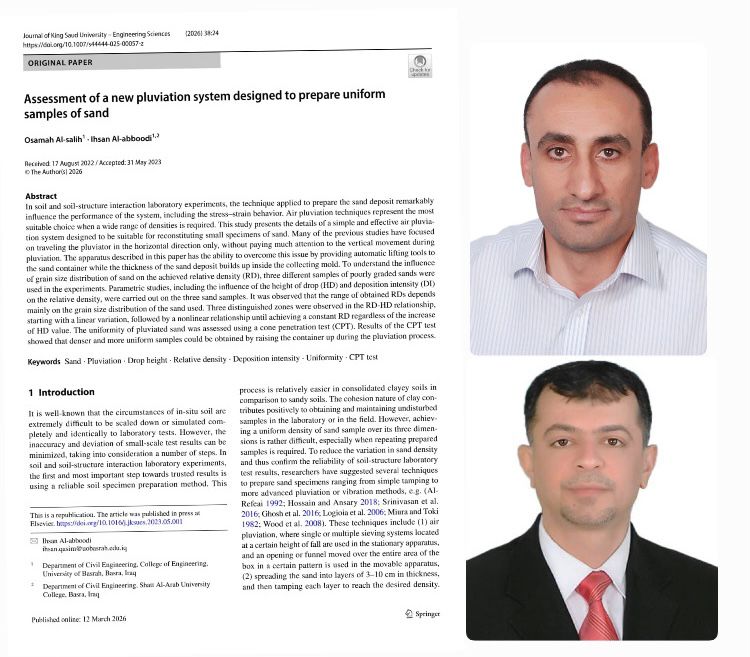
Important News


viewed most