Professor Dr. Ghaydaa Abdul-Razzaq Al-Suhail and graduate student Iman Ali Mohammed published a research paper in the international journal The Visual Computer (Springer Nature) International Journal of Computer Graphics. The journal is published by the international publishing house Springer Nature in Germany. It is ranked in the first quartile (Scopus Q1) with a CiteScore of 6.2 in the field of Computer Vision and Pattern Recognition, and in the second quartile (Clarivate JCR Q2) with a JIF impact factor of 3.4. It is indexed in the Web of Science (SCIE) in the Software Engineering and Computer Science category, ranking 44th out of 128 journals in this category.
The journal is ranked SJR Q2 in the Scimago Hindex 85.
The title of the paper is ResNet-OSD: an optimized hybrid deep learning framework for oil spill detection in coastal drone imagery
Rapid detection of oil spills is essential to prevent severe damage to marine ecosystems, safeguard public health, and protect coastal economic activities. This study proposes ResNet-OSD, a hybrid deep learning framework designed for accurate oil spill detection using drone imagery. The architecture builds on ResNet50’s strong feature extraction capabilities to address key challenges such as complex shoreline textures, variable lighting, and environmental noise. Two hybrid configurations were developed and tested on drone images from oil-contaminated coastal areas. Both models applied techniques to improve learning and address class imbalance: SMOTE and Borderline SMOTE for oversampling, PCA for dimensionality reduction, and K-fold cross-validation for reliable evaluation. The first model, ResNet-SVM, combines ResNet50 with a support vector machine and uses SMOTE and K-fold validation. The second, ResNet-PCA-RF, integrates ResNet50 with principal component analysis and a random forest classifier, applying Borderline SMOTE for more targeted synthetic sampling. Experimental results show that ResNet-PCA-RF achieved superior performance, with an ROC–AUC of 1.00, accuracy of 98.43%, precision of 97.67%, and recall of 99.21%. These findings emphasize the model’s robustness and efficiency in classifying oil spills, even under challenging environmental conditions.
https://share.google/o6WXnAVsfIc1b8295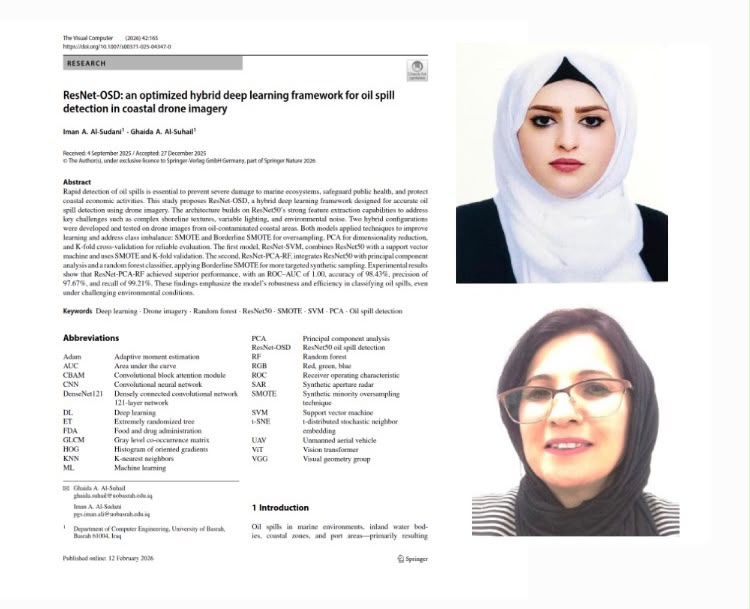
Important News



viewed most