Professor Dr. Mufid Turki Rashid, Dr. Mohammed Katea Jawda, and Dr. Ali Hassan Abdul-Al, faculty members at the College of Engineering, University of Basrah, in collaboration with researchers from international universities, published a scientific paper in the international journal Scientific Reports, ranked Q1. The paper is titled " Biomimetic climbing robot design inspired by geckos and cats for rough wall applications
This research presents the design of a quadrupedal robot capable of climbing rough surfaces. The robot’s shape, body, arms, and locomotion mechanism were inspired by the gecko, while its limbs were inspired by the limbs cats used to climb trees and grip rough surfaces. The robot has three degrees of freedom. Its grasping limbs were designed in an arched shape, with each limb equipped with seven claws so that each hook moves independently on the wall without overlapping, The arms were designed in a parallelogram shape and at the same level as the robot’s body to ensure stability during climbing and maintain the robot’s center of gravity close to the wall surface, enhancing gripping force and reducing the risk of slipping or falling. These features enable the robot to grasp, cling, and climb rough surfaces with greater ease. The motion algorithm applied to the climbing robot was inspired by the gecko algorithm, and a kinematic model was developed to calculate the displacement and position of the robot arm’s end-receiver. The robot’s body was designed using SolidWorks, and the robot’s body was fabricated and implemented using a 3D printer. Some system kinematics calculations were performed using MATLAB. Several climbing experiments were conducted on rough surfaces at 75° and 85° inclinations. In 15 trials on a 75° slope, the robot achieved a success rate of 93% demonstrating reliable performance. The robot’s climbing speed ranged from 20 to 60 cm/min. The experiments demonstrated the robot’s ability to climb and navigate on rough surfaces and uneven terrain efficiently and with stable performance.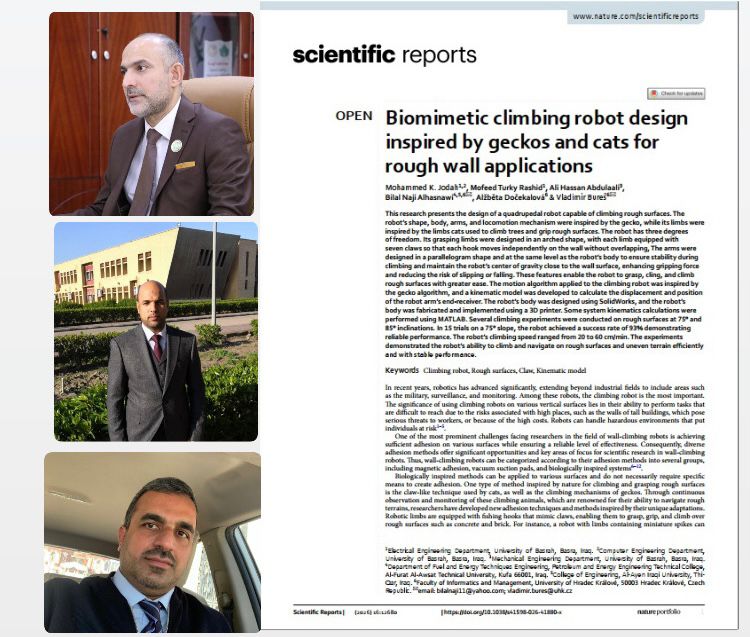
doi.org/10.1038/s41598-026-41880-x
Important News


viewed most