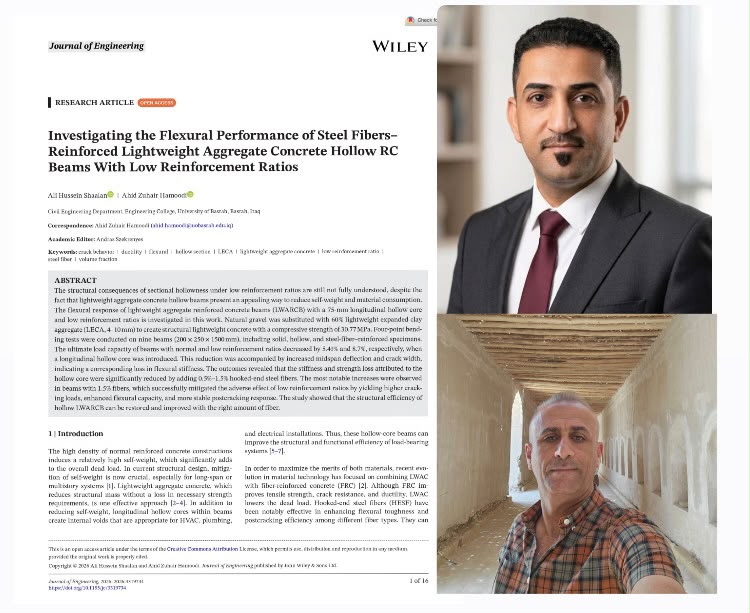
Assistant Lecturer Ali Hussein Shaalan and Dr. Ahed Zuhair Hamoudi have published a scientific research paper in the international journal Journal of Engineering—indexed in the Scopus database—published by Wiley.
The paper is titled: Investigating the Flexural Performance of Steel Fibers–Reinforced Lightweight Aggregate Concrete Hollow RC Beams With Low Reinforcement Ratios.
The structural consequences of sectional hollowness under low reinforcement ratios are still not fully understood, despite thefact that lightweight aggregate concrete hollow beams present an appealing way to reduce self-weight and material consumption.The flexural response of lightweight aggregate reinforced concrete beams (LWARCB) with a 75-mm longitudinal hollow core and low reinforcement ratios is investigated in this work. Natural gravel was substituted with 60% lightweight expanded clay aggregate (LECA, 4–10 mm) to create structural lightweight concrete with a compressive strength of 30.77 MPa. Four-point bend-ing tests were conducted on nine beams (200 × 250 × 1500 mm), including solid, hollow, and steel-fiber–reinforced specimens. The ultimate load capacity of beams with normal and low reinforcement ratios decreased by 5.41% and 8.7%, respectively, when a longitudinal hollow core was introduced. This reduction was accompanied by increased midspan deflection and crack width, indicating a corresponding loss in flexural stiffness. The outcomes revealed that the stiffness and strength loss attributed to the hollow core were significantly reduced by adding 0.5%–1.5% hooked-end steel fibers. The most notable increases were observed in beams with 1.5% fibers, which successfully mitigated the adverse effect of low reinforcement ratios by yielding higher crack-ing loads, enhanced flexural capacity, and more stable post cracking response. The study showed that the structural efficiency ofhollow LWARCB can be restored and improved with the right amount of fiber.
https://onlinelibrary.wiley.com/doi/10.1155/je/3319734
Important News
viewed most